

Parenting from the Flood Series, Part I: When Survival Becomes the Norm
When survival mode becomes your family’s baseline, safety becomes the revolution

The Flood
A mom posted something on Threads recently that stopped me mid-scroll:
“Being a parent with trauma is so hard. Once again your feelings just don’t fucking matter. It’s like being a child all over again. Except you’re not the child this time & if you fail, you perpetuate the same harm done to you.”
She went on to share that she’s exhausted, burnt out, and constantly masking because both she and her child are neurodivergent. She said, “Nobody believed me when I told them I was tired.”
I recognized her immediately: not by name, but by nervous system. She’s the parent I built my work for. The one who’s been surviving for so long that survival has started to feel like her whole personality.
The Shore
When you’re parenting from the flood, everything feels urgent. You’re always scanning, managing, preventing, protecting. Rest feels dangerous. Asking for help feels shameful.
The world doesn’t make it easier. Especially for Black parents. The expectations are relentless: be gentle but firm, strong but soft, independent but community-minded. All while healing from systems that were designed to break you.
And if you’re neurodivergent, the weight is doubled. You’re regulating a child while masking your own overwhelm. You’re trying to parent and perform at the same time.
From a trauma lens, this is what flooding looks like: the body never gets to come down. The nervous system is stuck in hypervigilance, convinced that if you slow down, everything will fall apart. As we’ve been reminded by the trauma world: our bodies keep the score, and we deserve opportunities for somatic safety (I highly encourage readers to dive into Resmaa Menakem’s work). And for many parents, that score reads like exhaustion disguised as strength.
The Bridge
When I responded to that mom, I told her:
“Not only does it make sense, I hear so much in what you shared. The exhaustion, the pressure, the constant pull between what your body needs and what your child needs; it’s all a symptom of how much you’ve carried without being supported yourself. Your body deserves the opportunity to experience life out of survival mode.”
She replied, “This sounds needed. I’ve been shouting this for years.”
That’s when it hit me: so many parents aren’t resistant to help, and the narrative that they have been is the shame-based that Shame Proof Parenting was designed to combat. What we’re seeing is what we call in the trauma-informed work: they’re flooded. They’ve been dismissed so many times that disbelief has become a reflex. Being flooded is the language of trauma that has overwhelmed your nervous system.
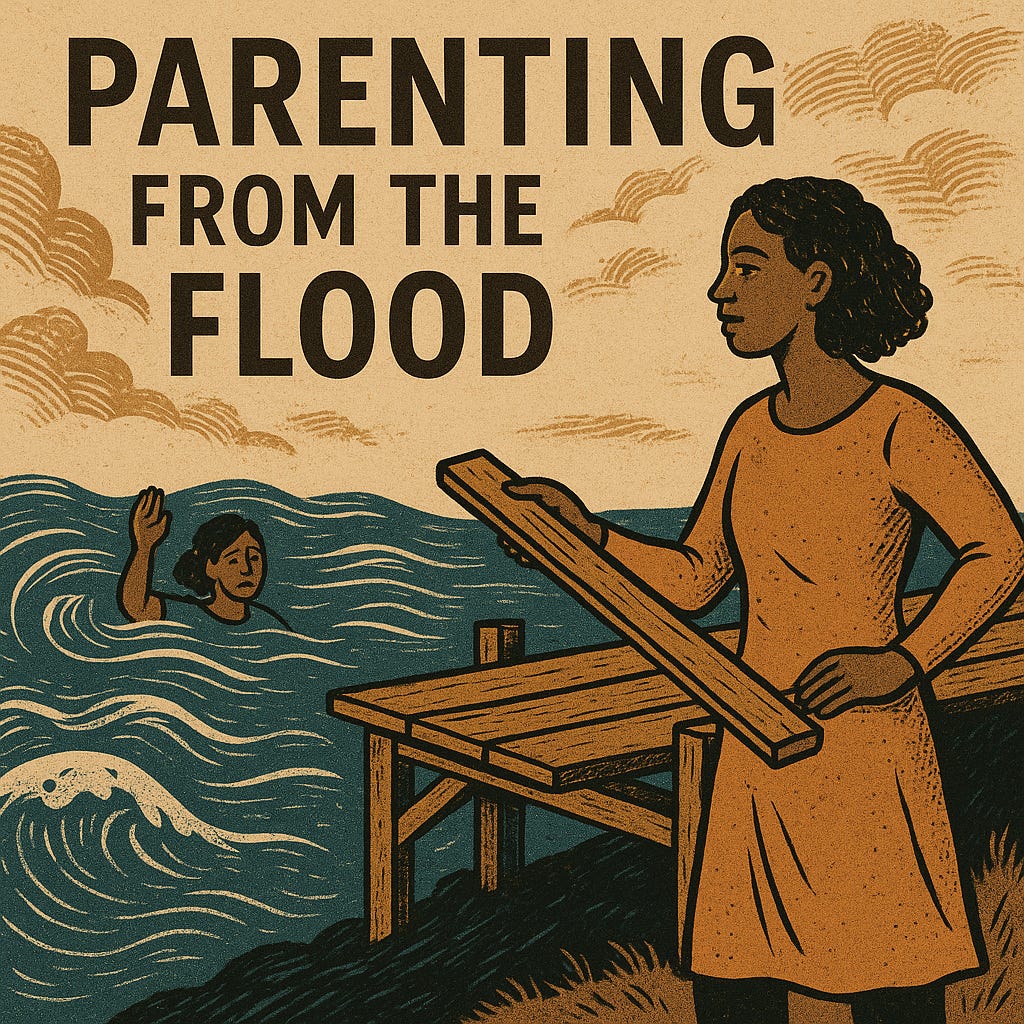
When we meet someone in the flood, our job isn’t to pull them out. It’s to stand on the shore, steady and patient, and build a bridge toward safety.
For me, that bridge is what Shame Proof Parenting has always been about: helping parents move from surviving to feeling, from self-blame to self-compassion. It’s what I mean when I say:
They are in the flood. I am on the shore building the bridge.
Reflection
If you’re reading this and realizing you’ve been parenting from the flood, I want you to take a slow breath right now.
Notice your shoulders. Your jaw. Your hands.
Your exhaustion isn’t failure. It’s information.
Your body isn’t betraying you. It’s begging for safety.
And safety isn’t selfish. It’s ancestral repair.
Because when you start parenting from the shore, grounded, aware, and compassionate, you teach your children what calm feels like. And that’s where generational healing begins.
Closing
This is the first in my new series, Parenting from the Flood, where I’ll explore what it means to parent, lead, and love while healing from trauma. Each essay will move through three stages: the flood (the story), the shore (the insight), and the bridge (the reframe).
If this resonates, stay connected. I’ll keep building the bridge one post at a time.